


Resource
Slim Profile vs Regular Aluminium Partition: An Honest Comparison
Compare slim profile and regular aluminium glass partitions based on design, strength, cost, privacy, and durability. Learn which system is better suited for offices, homes, and commercial interiors before making your investment.
Be-Slim Team
Choosing between a slim profile and a regular aluminium partition is one of the most important decisions when planning a glass partition project. While both systems perform the same basic function of dividing spaces, they differ in appearance, frame size, cost, flexibility, and overall architectural impact.
Slim profile partitions have become increasingly popular in premium offices because they maximize glass visibility and create clean, modern interiors. Traditional aluminium partitions, however, remain a practical and reliable solution for projects where durability, budget, and standard functionality are the primary priorities.
This guide compares both systems objectively to help you determine which partition is best suited for your office or home.
What Does a Slim Profile Actually Mean?
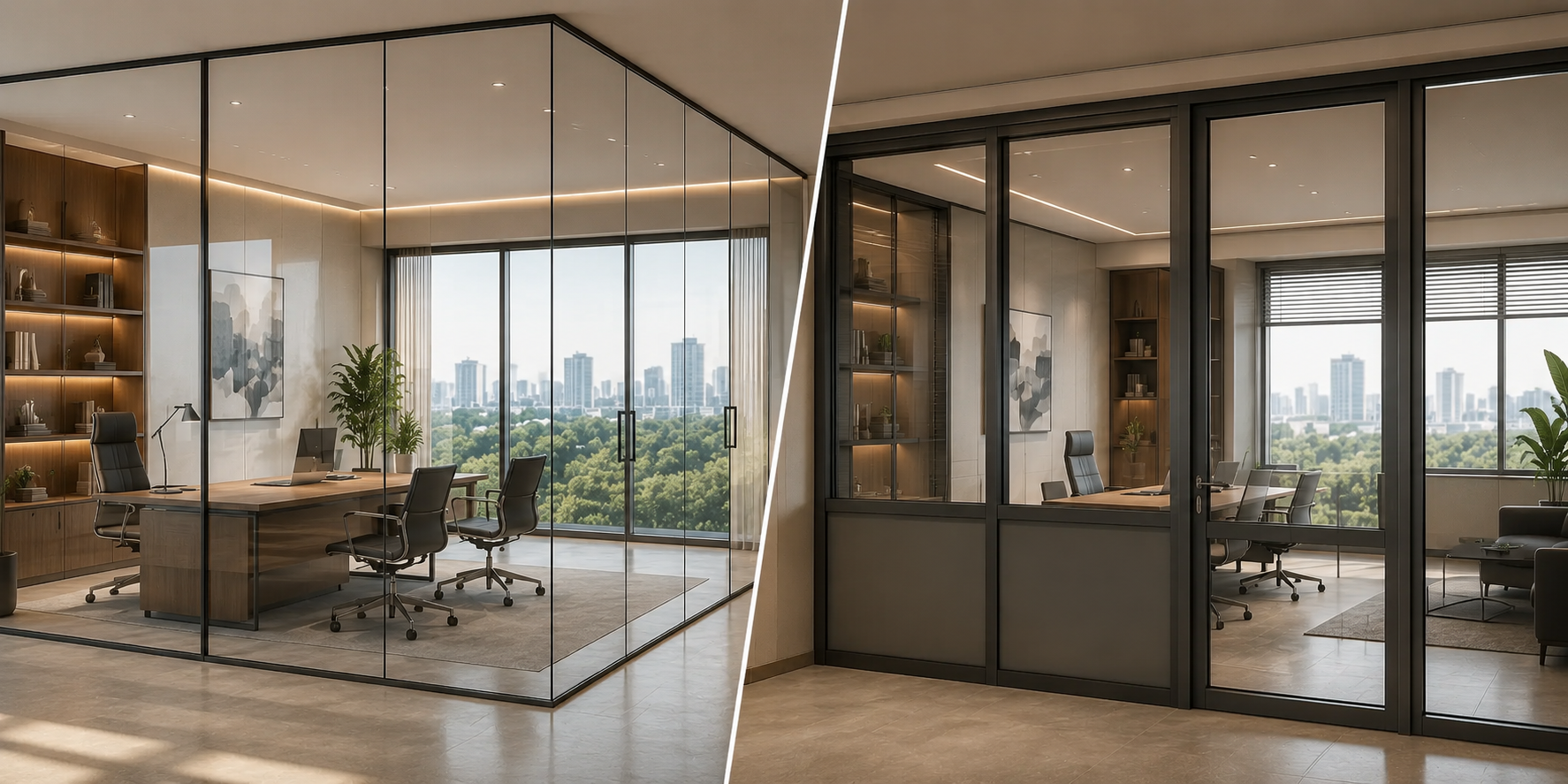
A slim profile partition uses narrow aluminium sections that hold the glass while minimizing the visible frame. The result is a cleaner appearance with larger uninterrupted glass surfaces.
Compared to conventional aluminium partitions, slim profile systems create brighter interiors because the reduced framing allows more daylight to pass through.
| Feature | Slim Profile | Regular Aluminium |
|---|---|---|
| Frame Width | Minimal | Wider |
| Visible Glass Area | Maximum | Moderate |
| Design Style | Modern | Traditional |
| Visual Impact | Premium | Functional |
Where Regular Aluminium Still Makes Sense
Although slim profile systems are increasingly popular, regular aluminium partitions continue to be widely used across commercial projects because of their affordability and proven reliability.
For warehouses, educational institutions, industrial offices, and budget-conscious commercial interiors, conventional aluminium framing remains an effective solution.
Best Applications
- Industrial offices.
- Educational institutions.
- Government buildings.
- Warehouses.
- Budget office projects.
Advantages
- Economical.
- Easy to maintain.
- Readily available.
- Suitable for large projects.
- Reliable long-term performance.
Cost Comparison
One of the biggest differences between the two systems is cost. Slim profile systems generally require precision manufacturing, premium aluminium sections, and higher-quality hardware.
| Cost Factor | Slim Profile | Regular Aluminium |
|---|---|---|
| Profile Cost | Higher | Lower |
| Hardware | Premium | Standard |
| Installation | More Precise | Simpler |
| Overall Investment | Higher | More Budget-Friendly |
While slim profiles require a larger initial investment, many businesses choose them because of their premium appearance and long-term design value.
Strength and Durability
A common misconception is that thinner profiles are weaker. In reality, modern slim profile systems are engineered to provide excellent structural performance when paired with the correct glass thickness and installation methods.
Both systems can provide long service life when designed and installed correctly.
| Attribute | Slim Profile | Regular Aluminium |
|---|---|---|
| Structural Strength | High | High |
| Corrosion Resistance | Excellent | Excellent |
| Maintenance | Low | Low |
| Expected Service Life | Long | Long |
Framed vs Frameless Appearance
When comparing a framed vs frameless glass partition, the difference is primarily visual. Slim profile systems closely resemble frameless glass because the visible aluminium is significantly reduced.
Regular aluminium partitions, on the other hand, create stronger visual boundaries due to their wider framing sections.
Slim Profile Benefits
- Minimal visual obstruction.
- Premium architectural appearance.
- Greater daylight transmission.
- Cleaner interior lines.
Which One Is Better for Offices?
Modern corporate offices increasingly prefer slim profile systems because they align with contemporary workplace design and create brighter, more collaborative environments.
| Office Type | Recommended System |
|---|---|
| Corporate Headquarters | Slim Profile |
| Executive Offices | Slim Profile |
| Creative Agencies | Slim Profile |
| Industrial Offices | Regular Aluminium |
| Budget Commercial Projects | Regular Aluminium |
Businesses looking for a premium workplace experience generally benefit from slim profile systems.
Which One Works Better for Homes?
Residential applications depend on both interior style and budget. Slim profile systems complement contemporary homes by creating clean sightlines, while regular aluminium systems remain practical for utility areas and cost-sensitive projects.
| Application | Recommended Option |
|---|---|
| Living Room Divider | Slim Profile |
| Home Office | Slim Profile |
| Kitchen Partition | Either System |
| Utility Areas | Regular Aluminium |
Five Questions Before Choosing a Partition System
- What is your overall project budget?
- Is modern appearance a priority?
- Will maximizing natural light improve the space?
- Does the project require premium architectural finishes?
- Will the partition remain in place for many years?
Quick Comparison
| Feature | Slim Profile | Regular Aluminium |
|---|---|---|
| Appearance | Premium | Traditional |
| Visible Glass | Maximum | Moderate |
| Cost | Higher | Lower |
| Maintenance | Low | Low |
| Best For | Modern Offices & Homes | Budget Commercial Projects |
Conclusion
There is no universal winner in the slim profile vs regular aluminium partition comparison. Slim profile systems deliver cleaner aesthetics, greater glass visibility, and a premium architectural finish, making them ideal for modern offices and contemporary homes. Regular aluminium partitions continue to offer excellent durability, affordability, and dependable performance for projects where practicality takes priority.
The best choice depends on your project's design goals, budget, and long-term expectations. By balancing appearance, functionality, and investment, you can select a partition system that provides lasting value and complements the overall character of your space.
Common questions
It depends on what you are looking for. Slim profile will give you a better premium look. More glass and less metal. And it’s slightly more expensive. Regular aluminium is less expensive and is perfectly adequate for staff storage or back office areas where you don’t really care what it looks like. For front-of-house staff areas, the slim profile is worth the extra dollars.
Yes, there is a reasonable markup. The increase in price is due to more accurate manufacturing, tighter tolerances, and better hardware. In a director cabin, a meeting room, or a living room where the divider is on show, the increase is worth it. In store rooms, it is probably not.
Absolutely. It’s all about the depth of the profile behind the glass, not the depth that you view from the front. It’s similar to an I-beam. If you have the proper glass thickness and installed correctly, the structural integrity of slim profile partitions is the same as normal partitions, especially considering their use indoors.