

Resource
Slim Aluminium Profile for Partition: A Technical Guide
Understand slim aluminium partition profiles, including profile anatomy, glass compatibility, finishes, hardware integration, and structural considerations for commercial and residential projects.
Be-Slim Team
Behind every reliable glass partition system is a carefully engineered aluminium profile. While glass receives most of the attention, the profile determines structural strength, alignment, durability, hardware compatibility, and the overall appearance of the installation. Choosing the right profile is essential for achieving both long-term performance and a clean architectural finish.
Modern slim aluminium profiles are designed to support large glass panels while minimizing visible framing. They combine precision manufacturing with high-strength aluminium alloys to create partition systems suitable for offices, commercial buildings, and premium residential interiors.
This guide explains the anatomy of a glass partition profile, material specifications, glass compatibility, finishes, and key technical considerations for architects, contractors, and project consultants.
Understanding the Anatomy of a Glass Partition Profile
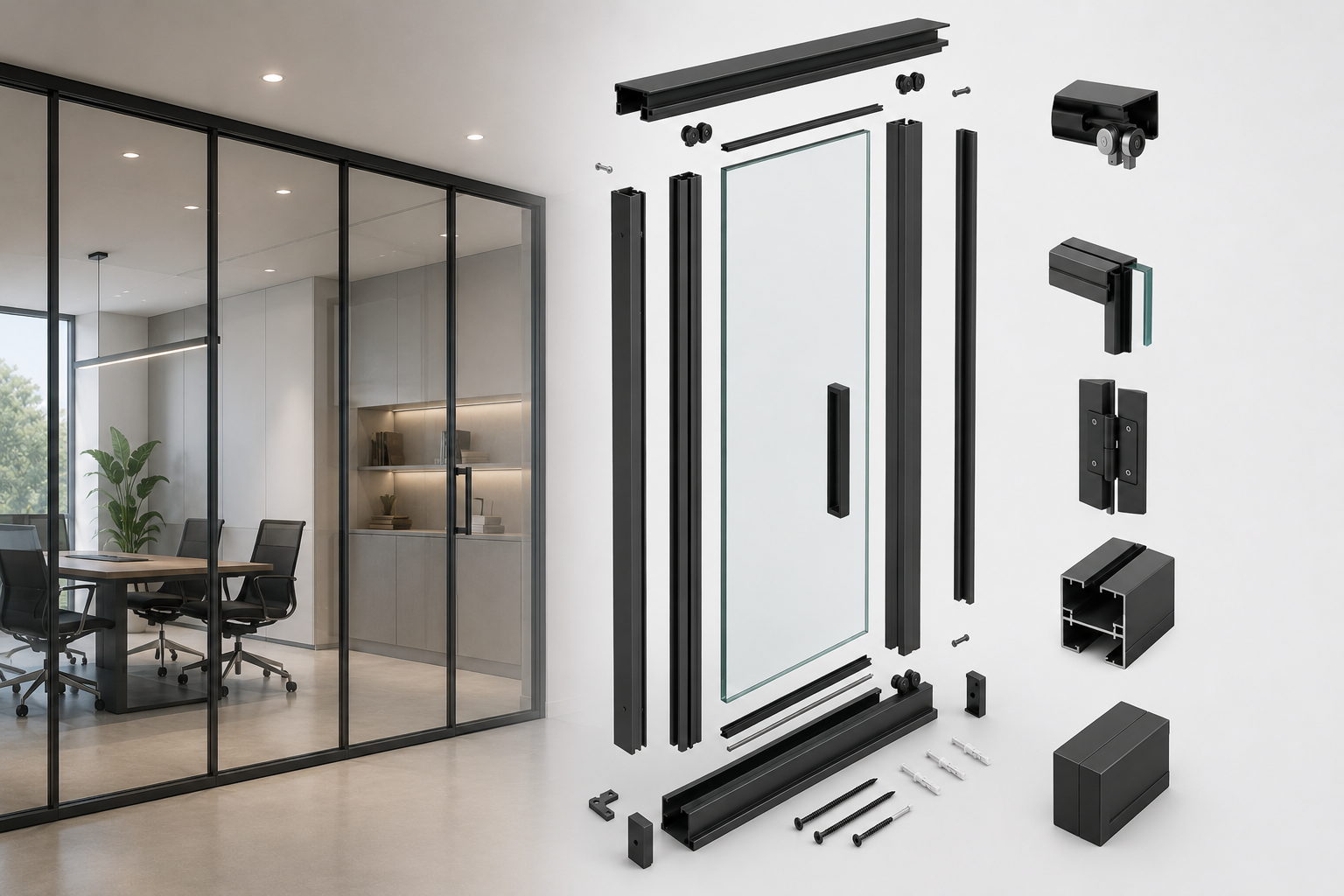
A complete aluminium partition system consists of several individual components that work together to support the glass and provide structural stability.
| Profile Component | Purpose |
|---|---|
| Base Channel | Anchors the partition to the floor or ceiling |
| Vertical Profile | Supports glass edges |
| Horizontal Profile | Provides structural stability |
| Glazing Beads | Secure the glass panels in position |
| Cover Caps | Create a clean finished appearance |
Each component plays an important role in maintaining alignment, rigidity, and long-term durability.
Aluminium Alloys and Material Specifications
Glass partition profiles are manufactured using architectural-grade aluminium alloys that offer an excellent balance of strength, corrosion resistance, and lightweight performance.
Quality aluminium profiles are engineered to resist deformation while supporting heavy glass panels without excessive frame thickness.
Benefits
- High strength-to-weight ratio.
- Corrosion resistance.
- Long service life.
- Minimal maintenance.
- Suitable for commercial interiors.
Glass Thickness Compatibility
Different profile sections are designed to accommodate specific glass thicknesses. Selecting compatible profiles ensures proper installation and long-term structural performance.
| Glass Thickness | Typical Application |
|---|---|
| 8mm | Residential partitions |
| 10mm | General office partitions |
| 12mm | Executive cabins and premium offices |
| Laminated Glass | Acoustic applications |
Always ensure that the selected profile section is compatible with the intended glass specification.
Anodized vs Powder-Coated Profiles
Aluminium profiles are commonly finished using anodizing or powder coating. Both finishes improve corrosion resistance while providing different aesthetic characteristics.
| Finish | Advantages | Best Use |
|---|---|---|
| Anodized | Excellent durability | Commercial offices |
| Powder-Coated | Wide colour options | Modern interiors |
| Matte Black | Contemporary appearance | Luxury offices |
| White Finish | Minimalist design | Residential projects |
The finish should complement the surrounding architecture while providing long-term surface protection.
Structural Considerations
Glass partitions are subject to various structural forces including panel weight, movement, and everyday usage. Profile selection should account for these conditions during project planning.
Important Factors
- Partition height.
- Glass panel size.
- Wind loads where applicable.
- Door locations.
- Building movement.
- Installation tolerances.
Proper engineering ensures the partition remains stable throughout its service life.
Hardware Integration
Modern profile systems are designed to accommodate a wide range of architectural hardware without compromising aesthetics.
| Hardware | Function |
|---|---|
| Hinges | Support hinged glass doors |
| Locks | Provide security and privacy |
| Sliding Tracks | Enable smooth door movement |
| Handles | Daily operation |
| Door Closers | Controlled door movement |
Using compatible hardware ensures smooth operation and reduces long-term maintenance.
Installation Best Practices
Even the highest-quality aluminium profile depends on accurate installation for optimal performance.
- Verify floor and ceiling levels.
- Use precise measurements.
- Maintain plumb vertical alignment.
- Install approved anchors.
- Seal profile joints correctly.
- Inspect alignment before glazing.
When to Request Technical Documentation
Large commercial projects often require supporting technical information before procurement and installation.
Useful documents include:
- Section drawings.
- CAD files.
- Product specifications.
- Installation guidelines.
- Hardware schedules.
- Material certifications.
Reviewing these documents early helps avoid specification conflicts during construction.
Common Specification Mistakes
- Selecting profiles without checking glass compatibility.
- Ignoring structural loading requirements.
- Using incompatible hardware.
- Choosing finishes unsuitable for the environment.
- Overlooking installation tolerances.
Quick Technical Comparison
| Feature | Importance |
|---|---|
| Aluminium Alloy | Structural strength |
| Glass Compatibility | Safety and performance |
| Surface Finish | Appearance and durability |
| Hardware Support | Functionality |
| Installation Accuracy | Long-term reliability |
Conclusion
A quality aluminium glass partition profile is far more than a decorative frame. It provides the structural foundation that supports the glass, integrates hardware, and ensures reliable long-term performance. Choosing the right profile involves evaluating material quality, finish, glass compatibility, and structural requirements rather than focusing on appearance alone.
By understanding how profile systems are engineered and specified, architects, contractors, and project owners can select partition solutions that combine durability, safety, and modern aesthetics for commercial and residential applications.
Common questions
Slim systems are based on architectural-grade aluminium extrusions mainly in the 6063 series. They are specific to glass partitioning. The exposed face width is 25 to 35 millimetres. That is, for a standard partition, it is half the width of the mullion.
Anodised gives you a natural metal finish in silver, champagne or bronze. It is very hard and does not flake. Powder coated gives you a wider choice of black, white, grey and custom colours. Both finishes are tough and the choice is only aesthetic.
Slim profiles employ a narrower visible face but greater depth behind the glass giving a less glass and more metal appearance. They are manufactured to much tighter tolerances, thus resulting in neater joints but less tolerance. Standard profiles are still suitable for service areas where visual appearance is less of a concern.