


Resource
How to Pick the Right Glass for Your Office Partition
Choosing the right glass for your office partition impacts privacy, natural light, acoustics, and aesthetics. This guide compares clear, frosted, fluted, tinted, toughened, and laminated glass to help you select the best option for every workspace.
Be-Slim Team
Choosing the right glass is one of the most important decisions when planning an office partition. The type of glass you select directly affects privacy, natural light, acoustics, safety, and the overall appearance of your workspace. While many offices prioritize aesthetics, selecting glass based solely on appearance can result in meeting rooms that lack privacy or executive cabins that feel unnecessarily enclosed.
Modern office partition systems offer several glass options, each designed for different workplace requirements. Whether you're creating collaborative workspaces, confidential HR cabins, premium executive offices, or client-facing meeting rooms, understanding the characteristics of each glass type helps ensure the finished space performs as intended.
This guide explains the most common office partition glass types and how to match them to different office functions.
Clear Glass: Maximum Openness and Natural Light
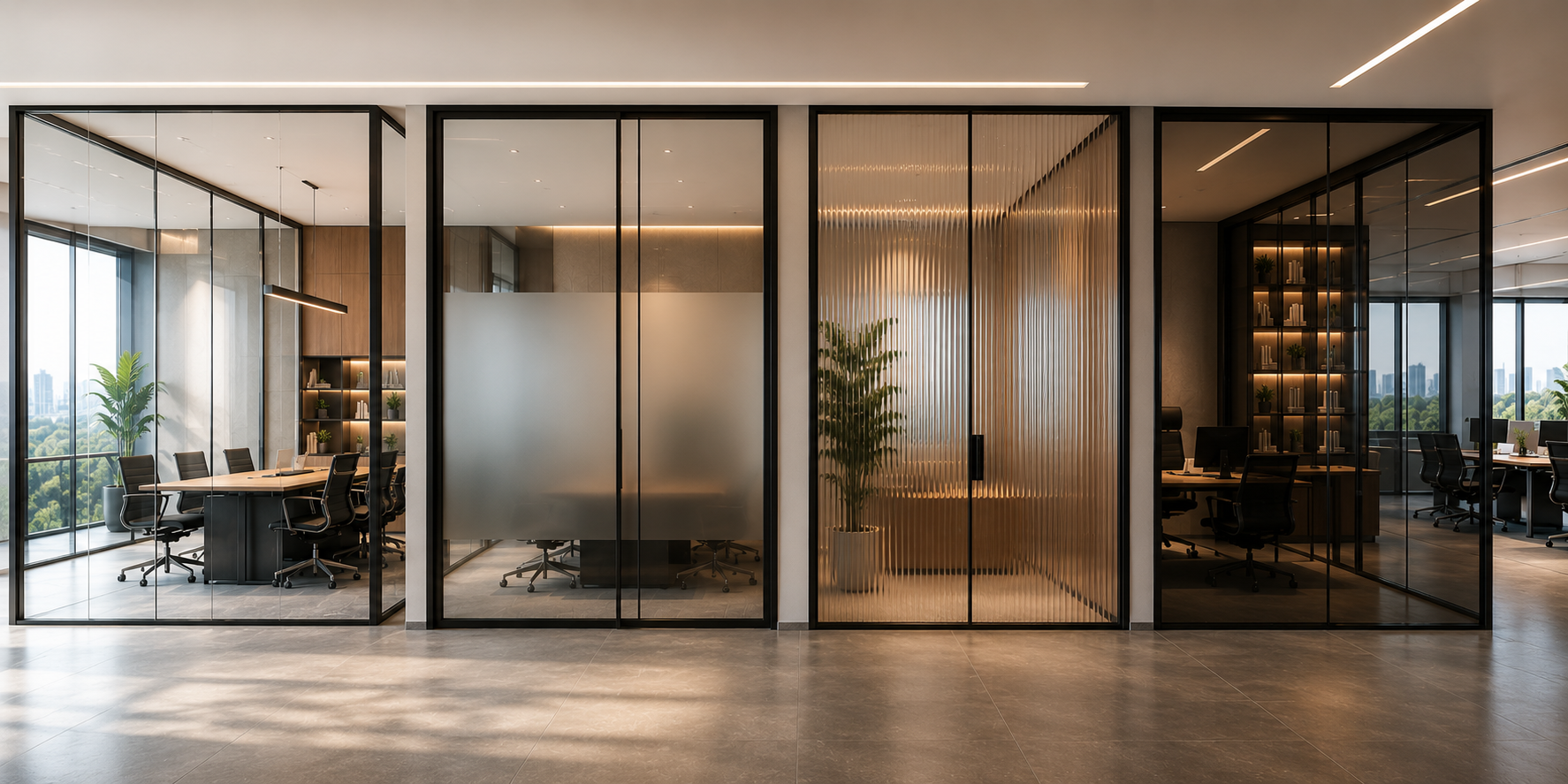
Clear glass remains the most popular choice for modern offices because it maximizes daylight and creates a spacious, open working environment. It allows employees to remain visually connected while making even smaller offices feel significantly larger.
Best Applications
- Reception areas
- Open collaborative offices
- Creative workspaces
- Director cabins that encourage accessibility
- Client-facing office spaces
Advantages
- Excellent natural light transmission.
- Creates a spacious appearance.
- Supports collaborative workplace culture.
- Timeless and modern design.
- Easy to maintain.
Limitations
- Provides little visual privacy.
- May require blinds or frosting in confidential spaces.
- Fingerprints are more visible in high-traffic areas.
Frosted Glass: Privacy Without Losing Daylight
Frosted glass diffuses light while preventing clear visibility through the partition. It is one of the most practical choices for offices where confidential discussions frequently take place.
| Feature | Frosted Glass |
|---|---|
| Privacy | High |
| Natural Light | Excellent |
| Appearance | Clean and professional |
| Best For | HR, Finance, Meeting Rooms |
Ideal Applications
- Human Resources cabins.
- Finance departments.
- Medical consultation rooms.
- Legal offices.
- Private meeting rooms.
Fluted Glass: Texture Meets Privacy
Fluted glass has become increasingly popular in premium office interiors. Its vertical grooves soften visibility while adding architectural texture that distinguishes executive spaces from standard office cabins.
Unlike fully frosted glass, fluted glass partially obscures vision while maintaining excellent daylight transmission, making it suitable for businesses seeking both privacy and premium aesthetics.
Advantages
- Designer appearance.
- Partial visual privacy.
- Excellent daylight penetration.
- Creates premium office interiors.
- Works well with slim aluminium profiles.
Best Applications
- Executive cabins.
- Creative agencies.
- Architectural firms.
- Luxury office interiors.
Tinted Glass for Sun-Facing Offices
Tinted glass adds a subtle colour tone while helping reduce glare in offices exposed to strong sunlight. Although it does not replace dedicated solar-control glazing, it improves visual comfort in bright environments.
| Benefit | Description |
|---|---|
| Reduced Glare | Improves visual comfort near windows. |
| Modern Appearance | Adds subtle colour and depth. |
| Light Control | Slightly reduces brightness. |
| Best For | South and west-facing offices. |
Tinted glass is commonly selected where comfort and aesthetics are equally important.
Toughened vs Laminated Glass
Many buyers confuse safety glass types. While both toughened and laminated glass improve safety compared to ordinary glass, they serve different purposes.
| Feature | Toughened Glass | Laminated Glass |
|---|---|---|
| Primary Benefit | Impact Resistance | Acoustic & Security Performance |
| Breakage Pattern | Small blunt fragments | Glass remains bonded together |
| Sound Reduction | Moderate | Better |
| Best Applications | General Office Partitions | Boardrooms, Executive Cabins |
Toughened glass is the standard choice for most office partitions, while laminated glass is often preferred where speech privacy and additional security are priorities.
Partial Frosting and Privacy Bands
Not every office requires full frosted glass. Partial frosting, often applied as horizontal bands, provides seated privacy while maintaining openness above eye level.
Advantages
- Balances openness with privacy.
- Allows daylight to pass through.
- Maintains visual connection across the office.
- Supports contemporary office aesthetics.
- Suitable for most corporate environments.
Privacy bands are particularly common in meeting rooms, manager cabins, and collaborative office spaces.
Choosing the Right Glass for Each Office Space
| Office Area | Recommended Glass |
|---|---|
| Reception | Clear Glass |
| Open Workspace | Clear Glass |
| Manager Cabin | Partial Frosted Glass |
| Executive Cabin | Fluted or Laminated Glass |
| HR Department | Frosted Glass |
| Finance Office | Frosted or Laminated Glass |
| Boardroom | Laminated Glass with Privacy Band |
| Creative Studio | Fluted Glass |
Factors to Consider Before Choosing Office Partition Glass
- Required privacy level.
- Amount of natural daylight available.
- Need for acoustic performance.
- Safety requirements.
- Office branding and interior design.
- Future flexibility of the workspace.
- Maintenance expectations.
Common Mistakes to Avoid
- Using clear glass in confidential meeting rooms.
- Selecting frosted glass for highly collaborative spaces.
- Ignoring acoustic requirements.
- Choosing glass based only on appearance.
- Overlooking future office expansion plans.
- Using ordinary glass instead of safety glass.
Quick Comparison of Office Partition Glass Types
| Glass Type | Privacy | Natural Light | Acoustic Performance | Best Use |
|---|---|---|---|---|
| Clear Glass | Low | Excellent | Moderate | Reception & Open Offices |
| Frosted Glass | High | Excellent | Moderate | HR & Finance |
| Fluted Glass | Medium | Very Good | Moderate | Executive Cabins |
| Tinted Glass | Medium | Good | Moderate | Sun-Facing Offices |
| Laminated Glass | Depends on Finish | Excellent | High | Boardrooms |
Conclusion
The best office partition glass types are those that match the function of each workspace rather than following a single design trend. Clear glass encourages collaboration, frosted glass protects confidentiality, fluted glass adds architectural character, tinted glass improves comfort in bright environments, and laminated glass enhances acoustic performance for executive spaces.
By considering privacy, natural light, acoustics, safety, and long-term workplace requirements, you can confidently select the best glass for office partition projects that deliver both functionality and modern design.
Common questions
Sure, and often it looks even better than anticipated. A glass panel makes a room seem larger, allows light to penetrate, and gives a glass panel more aesthetic appeal than drywall. In a modern, contemporary, or traditional style, the light aluminum frame is non-intrusive. It is not the one to take all the credit.
Yes. The panels are cut according to your requirements. You can select from different types of glass, choose the colour of the frame, specify the hardware and choose fixed, sliding or openable sections. Any frosting pattern can be tailored. Tell us what you need and it will be built to fit.
Yes. The aluminium frame system and hardware are covered by a manufacturer’s warranty. The glass panels come with standard warranty provisions for safety glass. The installation workmanship carries a warranty. All of the above is included in your quotation.