


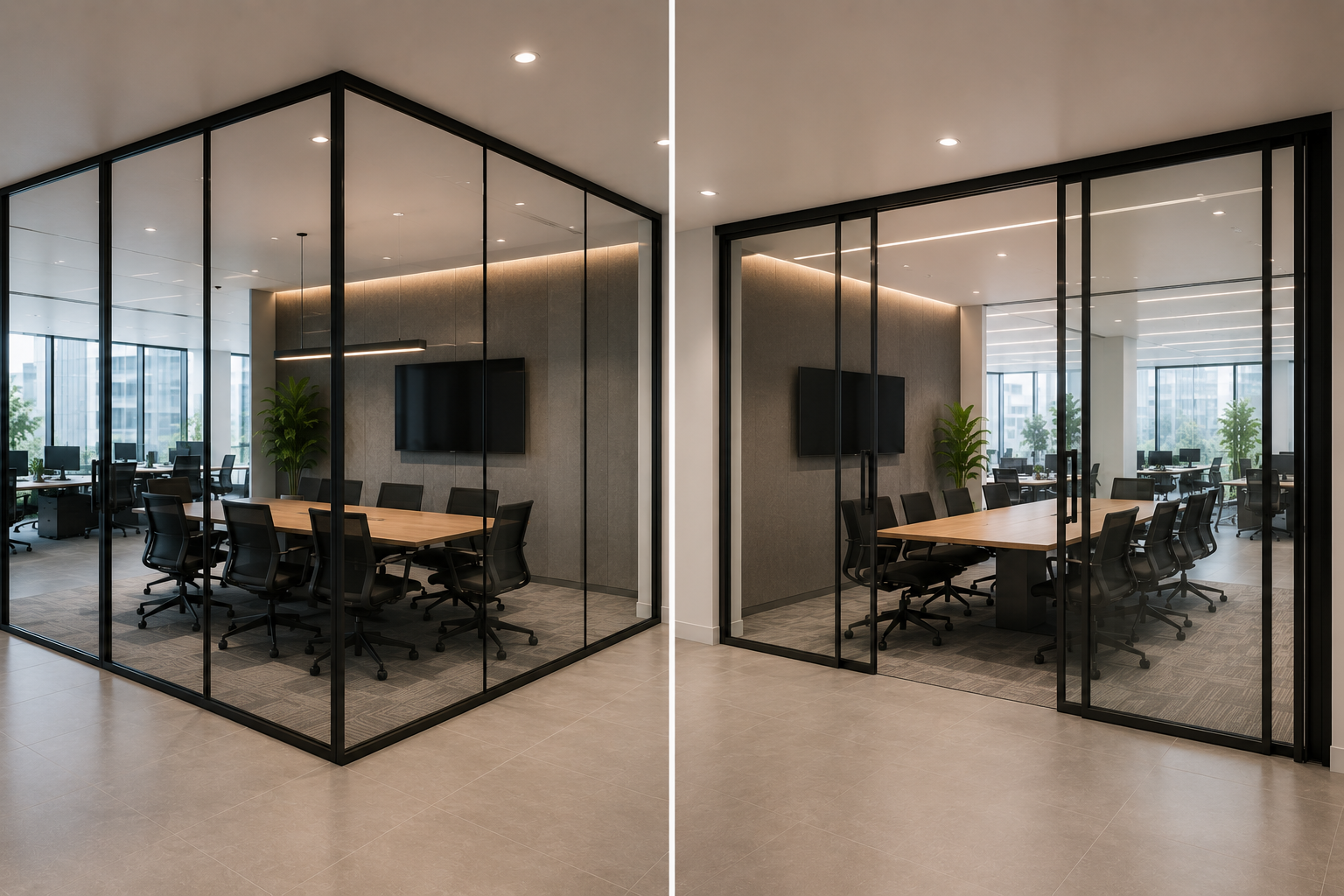
Resource
Fixed vs Sliding Glass Partition: How to Decide
Not sure whether to choose a fixed or sliding glass partition? Compare space requirements, cost, privacy, maintenance, and ideal applications to select the right system for your office or home.
Be-Slim Team
Choosing between a fixed glass partition and a sliding glass partition is one of the most important decisions when designing an office or home interior. While both systems provide a modern appearance and improve natural light, they serve different purposes. The right choice depends on available space, privacy requirements, flexibility, maintenance expectations, and budget.
Fixed partitions are known for their simplicity and durability, whereas sliding systems provide adaptability and efficient space utilization. Understanding how each option performs in real-world applications helps you make an informed investment rather than selecting a system based only on appearance.
This guide compares fixed and sliding glass partitions across the factors that matter most for residential and commercial projects.
Understanding Fixed Glass Partitions
A fixed glass partition is permanently installed and does not move once fitted. It provides a stable, low-maintenance solution for dividing spaces while maintaining an open and bright environment.
Advantages
- Simple construction.
- Minimal maintenance.
- Excellent structural stability.
- Lower hardware requirements.
- Cost-effective installation.
Fixed systems are ideal where room layouts are expected to remain unchanged for many years.
How Sliding Glass Partitions Work
A sliding glass door partition operates using overhead or floor-mounted tracks that allow glass panels to move horizontally. These systems make it possible to divide or open spaces whenever required.
Sliding partitions are particularly useful in offices, apartments, and multipurpose rooms where flexibility is important.
| Feature | Sliding Partition |
|---|---|
| Movement | Horizontal |
| Space Saving | Excellent |
| Flexibility | High |
| Best Application | Multi-purpose spaces |
Space Requirements
One of the biggest differences between the two systems is how much floor space they require.
| Feature | Fixed | Sliding |
|---|---|---|
| Door Clearance | Not Applicable | No Swing Space Needed |
| Wall Space | Minimal | Track Length Required |
| Compact Rooms | Good | Excellent |
| Large Open Areas | Excellent | Excellent |
Sliding partitions work particularly well where swing doors would interfere with furniture or circulation.
Cost Comparison
Budget often plays an important role when deciding between fixed and sliding systems. Fixed partitions generally cost less because they require fewer moving components.
| Cost Factor | Fixed | Sliding |
|---|---|---|
| Hardware | Minimal | Premium Track System |
| Installation | Simpler | More Complex |
| Maintenance | Lower | Moderate |
| Overall Cost | Generally Lower | Generally Higher |
The additional hardware and installation precision make sliding systems a higher initial investment.
Privacy and Acoustic Performance
Both systems can provide good visual privacy depending on the selected glass finish. However, acoustic performance differs because of the way the systems are constructed.
| Feature | Fixed | Sliding |
|---|---|---|
| Visual Privacy | Excellent | Excellent |
| Acoustic Performance | Better | Moderate |
| Air Sealing | Excellent | Moderate |
Sliding doors typically leave small operational clearances around the panel, making fixed systems more effective for sound control.
Which System Fits Different Spaces?
| Application | Recommended System |
|---|---|
| Executive Cabin | Fixed Partition |
| Meeting Room | Either System |
| Training Room | Sliding Partition |
| Living & Dining Area | Sliding Partition |
| Reception Area | Fixed Partition |
| Home Office | Sliding Partition |
The intended function of the room should always guide the final decision.
Maintenance Requirements
Both systems require relatively little maintenance, but sliding partitions involve additional moving components.
- Clean glass regularly.
- Inspect aluminium profiles.
- Lubricate sliding hardware when recommended.
- Keep tracks free from dust and debris.
- Check door alignment periodically.
Fixed partitions generally require less ongoing maintenance because they contain fewer mechanical parts.
Six Questions to Help You Decide
- Will the room layout change in the future?
- Is maximum privacy required?
- How important is space saving?
- What is the available project budget?
- How frequently will the partition be opened?
- Is acoustic performance a priority?
Common Selection Mistakes
- Choosing sliding systems where layouts never change.
- Ignoring track maintenance requirements.
- Selecting fixed partitions where flexibility is needed.
- Comparing systems based only on price.
- Overlooking acoustic performance.
Quick Comparison
| Feature | Fixed Partition | Sliding Partition |
|---|---|---|
| Flexibility | Low | High |
| Maintenance | Minimal | Moderate |
| Privacy | Excellent | Good |
| Acoustic Performance | Better | Moderate |
| Space Saving | Good | Excellent |
| Cost | Lower | Higher |
Conclusion
There is no single answer to which glass partition is better, fixed or sliding. Fixed partitions offer simplicity, durability, and excellent privacy, making them ideal for permanent layouts. Sliding systems provide flexibility, efficient space utilization, and adaptable interiors that suit changing residential and commercial needs.
Evaluating your available space, privacy expectations, maintenance preferences, and future layout requirements will help you select the partition system that delivers the best long-term value for your project.
Common questions
The price depends on your glass type, the thickness, whether it is fixed or sliding, the hardware you pick, and how big the opening is. Frosted and fluted glass cost more than clear. Sliding costs more than fixed. Share your cabin dimensions and preferences and you will get an actual number, not a guess.
Fixed is easier and cheaper. Go for it for permanent partitions such as a dining area that will always remain divided. Sliding is ideal for flexible spaces; open up to the living room when entertaining friends, but conceal from view when cooking. Most houses use a combination of the two.
Let us know your name, is it for an office or home, approximately what the size of the opening is, what type of glass you would like, and if it is to be a fixed, sliding, or openable system. If you can, attach the photos or floor plans, that is even better. If you are not completely certain about the specifics, tell us what you know and we can assist you.